On today’s market, every savvy seller wants to know what turns buyers off, so they can get their homes sold as quickly as possible, for as much as possible. But buyers, take note – there is a minefield of seller turn-offs you can trigger that hold the potential to keep you from getting the home you want at the best price and terms, or to unnecessarily complicate dealings with your home’s seller.
Lest you think all of today’s sellers are under the gun and will just put up with whatever behavior buyers dish out, be aware that there are still many multiple offer situations in which buyers have to compete with each other to get a home – buyers who trigger these turnoffs tend to lose in those scenarios. Also, avoiding these seller turnoffs can create a transactional environment of cooperation and avoid things turning adversarial. That, in turn, can empower you to score a better price, get extra items you want thrown into the deal, and even negotiate more flexibility around your escrow and move-in timelines – all perks that can make your life easier and your budget go further.
For sellers, these turnoffs pose the potential of irritating you out of an otherwise good deal – maybe even the only deal you have!
Here’s a few of the most common buyer-perpetuated seller turnoffs, with tips for sellers on how to keep an emotional (and economic) even keel, even if your home’s buyer makes some of these waves:
1. Trash-talking. Trash-talkers are the home buyers who think they’re going to negotiate the list price down by slamming the house, telling the sellers how little it is really worth, how the house across the street sold for nothing, why the school on the corner should make them desperate to give the place away, etc. This strategy never works; in fact, when you attack a seller and their home, you only cause them to be defensive, and think up all the reasons that (a) their home is not what you say it is, and (b) they shouldn’t sell their home to you!
Sometimes this happens with buyers who actually love a house and just walk around it fantasizing about all the ways they would customize it to their tastes while a seller is there. Sellers: avoid being at home while your home is being shown. Buyers: save your commentary for your agent; if you do encounter the seller in person keep your conversation respectful and avoid critiquing the house or the list price.
2. Being unqualified for mortgage financing. When a seller signs a buyer’s offer, most often the seller agrees to effectively pull the home off the market, forgoing other buyers who might be interested. As such, the only thing worse than getting no offers on your home is getting an offer, getting into contract, then having the whole thing fall apart when the buyer’s loan falls through – especially if that could have been predicted or avoided up front.
Sellers: Work with your agent to vet your home’s buyers’ qualifications, including their loan approval, down payment and earnest money deposit – before you sign a contract. It’s not overkill for your agent to call the buyers’ mortgage pro before you sign the contract and get a level of comfort for how robust their qualifications are. Buyers: Get pre-approved. Seriously. And make sure that you don’t buy a car, quit your job, deposit lottery winnings or do any other financial twitchery between the time you get loan approval and the time you close escrow on your home.
3. Making unjustified lowball offers. No one likes to feel like they are being taken advantage of. And sellers generally know the ballpark amount that their home is worth, as well as what they need to sell it for to get their mortgage paid off. Yes – the price you pay for a home should be driven by its fair market value, rather than the seller’s financial needs, and deals are more available in a market like the current one, in which supply so vastly outpaces demand. But just throwing uber-lowball offers out at sellers hoping one will hit the spot is not generally a successful strategy, especially if you really, really want a given property.
Sellers: Don’t get overly emotional about receiving a lowball offer; counter at the price you and your agent decide makes sense based on the total circumstances, including your motivation level, recent comps and the interest/activity level your listing is receiving. Buyers: Work through the similar, nearby homes that have recently sold (a/k/a comparables) before you make an offer to factor the home’s fair market value into your offer price – also factor in how much you want the place, too. Don’t be amazed if you make an offer far below asking, and don’t get a response.
4. Renegotiating mid-stream. Sellers plan their finances, moves and - to some extent – their lives around the purchase price a buyer agrees to pay for their home. If you get into contract to buy a home, find out during inspections that costly repairs need to be made, then propose a lower sale price, repair credit or even actual repairs to the seller, that’s sensible and fair. But if you were aware that the property needed a lot of work before you made an offer on it, then you come back asking for beaucoup bucks’ worth of credit or price reductions midstream, expect the seller to cry foul. And holding the seller up two weeks into the transaction because you caught a case of buyer's remorse? Not cool, and not likely to foster the spirit of cooperation you may need to get your deal closed.
Sellers: avoid mid-stream price renegotiations by having a full set of inspection reports and repair bids at hand when you list your home. Buyers: try to avoid renegotiating the entire deal unless you get some major surprises at your inspections or inflating small repairs to try to justify a major price cut.
5. Misleading or setting the seller up. Remember when we talked about buyer turn-offs? Being misled by listing photos or very fluffy property descriptions was high on the list. The same goes for sellers.Offering way over asking with the plan to hammer the seller for a reduction when the house doesn’t appraise at the purchase price? #LAME Making an as-is offer planning the whole time to come back and ask for every penny ante repair called out by the inspectors? Lame squared.
Sellers: If you get multiple offers and are tempted to take a sky-high one or one that claims to be all cash, consider requesting proof that the buyer has sufficient funds to make up the difference between what you think the home will appraise for and the actual sale price, and statements showing the cash truly exists. Buyers: Don’t be lame. I’m not saying you have to tell the seller exactly what your top dollar is, but making offers with terms designed to intentionally mislead is really, really bad form – and can result in losing the home entirely if and when your bluff gets called.
Tuesday, April 12, 2011


Friday, April 8, 2011
Unemployed Loan Program Now Available!!!
It's here! Unemployed homeowners can now receive loans that will help them avoid foreclosure, thanks to a new program by the Obama administration.
After delays and efforts to terminate the program, the $1 billion Emergency Homeowners' Loan Program–established when the Dodd-Frank financial overhaul bill was enacted in the summer of 2010–is now ready to help unemployed homeowners to continue to make their mortgage payments.
The program will allow qualified unemployed homeowners to receive zero-interest loans of up to $50,000 and for up to two years. The loan can be forgiven if the homeowner stay in the house five years. Requirements include being at least three months behind on your payments but also having a reasonable ability to resume payments within the two-year period. Additionally, homeowners have to have had a 15% decrease in income. However, they must have been able to pay for their mortgage prior to the income drop. They can't own a second home and the property has to be their primary residence.
Included in this latest emergency relief effort are: Pennsylvania ($106 million), Maryland ($40 million), Connecticut ($33 million), Idaho ($13 million), and Delaware ($6 million).
Coming soon, nonprofit NeighborWorks America, is providing federal funding for loans in 27 other states that don't have a similar program. The Department of Housing and Urban Development expects some 30,000 homeowners to participate.
Other states such as California, Nevada, Michigan, and a few more are expecting to receive some aid through the Treasury Department, which has allotted $7.6 billion in assistance for hard-hit states.
Meanwhile, housing-market analysts are saying that for long-term real estate recovery to occur, live-in homebuyers are necessary. Experts acknowledge that markets such as Phoenix, Arizona were propped up by very low interest rates, investor demand, and some of the most affordable home prices ever seen.
But experts say that buyers who are purchasing to live in the home will help stimulate the housing recovery process. In some markets, like Phoenix, it's been a 50-50 split between live-ins and investors.
Some of the factors holding back traditional buyers from dominating the market are, of course, stricter requirements for lending, unemployment, or lack of sufficient work, and uncertain financial times.
Live-in homebuyers tend to come from one of two groups: first-time or move-up buyers. With the recent marketplace and economic conditions being so unstable, and a decline in home value, the move-up buyers have not been very active. But some real estate experts are seeing an emergence of a new buyer group: lower-income residents. This group can now afford to buy because the home prices, in some areas, have declined significantly. However, in many areas, home investors are vying for those same properties, creating competition.
In a perhaps surprising move, some home auctions, where investors can typically scoop up a great deal, are now excluding investors. A California-based firm is helping to get rid of all foreclosed Arizona homes for which the previous owners had U.S. Federal Housing Administration-backed loans. The U.S. Department of Housing and Urban Development's policy gives traditional buyers at least 30 days to bid on new listings first. Then the properties may be opened up to investors. Homes in the Phoenix area are being sold online at HudHomeStore.com.
Wednesday, April 6, 2011
PHOENIX REAL ESTATE MARKET REPORT - MARCH 2011




Phoenix Real Estate Market Report Summary
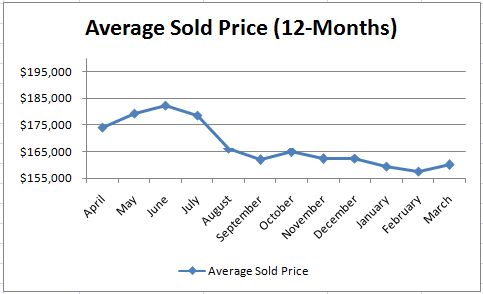
This data includes single family detached homes, patio homes, condos, and townhomes provided by the Arizona Multiple Listing Service. The monthly charts above are based on trailing twelve monthly averages from April 2010 to March 2011 which shows the total activity in the Phoenix Metropolitan real estate market over a twelve month period. The yearly charts above are based on a yearly average for 2005 to 2009 but a trailing twelve month average from April 2010 to March 2011 for the year 2011. Without the trailing twelve month average for the year 2011, the charts would be substantially skewed and would not portray an accurate view of the market on an annual basis.
Since the expiration of the first time home buyer tax credit on April 30, 2010, the real estate market has decreased in the average sold price and number of transactions. Since April 2010, the average sold price has decreased approximately -8.1% (up from last month), the average days on market have increased approximately +17.7% (down from last month) and the number of transaction has increased approximately 8.2% (up substantially from last month). Since April 2010, the number of sold bank owned foreclosures has increased approximately 15.7% (doubled since last month) and the number of short sale has increased only approximately 4% (up slightly from last month). Based on this information, it appears there is an oversupply of properties on the market and if banks continue to add more foreclosure inventory to the market, then this will continuing to cause prices to fall. It also appears demand in the market is stronger than the prior year and the results can be seen in the increased number of transactions. If demand for real estate exceeds supply, then price will start to appreciate once again. The peak buying season in the Phoenix market generally does not begin until March or April and then slows down slightly in July and August.
The number of Notice of Trustee Sales is currently experiencing a decline due to increased government intervention to make lending institution work hard on helping people stay in their homes. The number of foreclosures “notices” entering the market is expected to decline in late 2011 and early 2012 due to the exhaustion of adjustable rate mortgages created between 2003 to 2007. Although the number of foreclosure notices will decline, there are still a lot of homeowners upside down and a lot of these homeowners will make a business decision to let their homes go into foreclosure despite the fact they can continue paying their mortgage. The number of trustee’s deeds issued at the trustee auctions is on a steep incline which means the competition for trustee properties has increased over the last two months due to the lower supply of foreclosure. There is a large amount of properties sold at the court house steps but there is still a large amount of REO properties sold through the MLS. According to the above market statistics, the demand for trustee sale foreclosures has increase substantially and the demand for REO properties is increasing. It is impossible for real estate prices to go down much further since the market will eventually reach a level of equilibrium where demand will exceed supply and all buyers will rush into the market to take advantage of low prices before the prices start to increase. A lot of investors and home buyer have already realized that now is the best time to buyer while prices are low.
Wednesday, March 23, 2011
Shea adds 55-plus community to Encanterra
Trilogy by Shea Homes has added a 55-and-over community to Encanterra, the San Tan Valley area development that sports a 60,000-square-foot clubhouse. Shea said in a release that Trilogy at Encanterra is the "first age-qualified community to open in several years in the Southeast Valley."
TWO COMMUNITIES
The addition means Encanterra now has two communities, one for all ages and the other for people over 55. Hal Looney, Arizona area president of Shea Homes Active Lifestyle Communities, said the company made the move to "accommodate requests for an age-qualified neighborhood, and provide affordable luxury for consumers who have certainly spent a lifetime earning it." The community has 50 homes so far with seven floor plans, priced from the mid-$140s.
The addition means Encanterra now has two communities, one for all ages and the other for people over 55. Hal Looney, Arizona area president of Shea Homes Active Lifestyle Communities, said the company made the move to "accommodate requests for an age-qualified neighborhood, and provide affordable luxury for consumers who have certainly spent a lifetime earning it." The community has 50 homes so far with seven floor plans, priced from the mid-$140s.
CLUB A BIG DRAW
Looney said a big draw for prospective homebuyers in both Encanterra communities has been membership privileges in the private La Casa, which includes four restaurants and bars, a wine-tasting venue, a full-service spa, the Mallorca Event Center, and an athletic club with a women-only gym, three pools, lighted championship tennis courts, and an outdoor amphitheater.
Looney said a big draw for prospective homebuyers in both Encanterra communities has been membership privileges in the private La Casa, which includes four restaurants and bars, a wine-tasting venue, a full-service spa, the Mallorca Event Center, and an athletic club with a women-only gym, three pools, lighted championship tennis courts, and an outdoor amphitheater.
Free help for struggling homeowners
A group of housing-assistance organizations is hosting an all-day event Thursday in downtown Phoenix for Arizona homeowners who are behind on their mortgages or may be at risk of foreclosure.
The Free Help for Homeowners Community Event is scheduled for 11 a.m. to 7:30 p.m. at the Phoenix Convention Center, 100 N. Third St.
It is a joint effort by the Obama Administration's Making Home Affordable Program, lending-industry consortium Hope Now, and non-profit community development organization NeighborWorks America.
Organizers said the event will provide a chance for homeowners to meet face to face with their mortgage company and a HUD-approved counseling agency to work on a solution to help them stay in their homes.
Friday, March 18, 2011
5 Mortgage and Foreclosure Myths
In a mortgage market that changes as quickly as this one, today’s fact is tomorrow’s fiction. For buyers, misinformation can be the difference between qualifying for a home loan or not. Sellers and owners, knowledge is foreclosure-preventing, smart decision-making power! Without further ado, let’s correct some common mortgage misconceptions.
1. Myth: Buyers with bad credit can’t qualify for home loans. Obviously, mortgage guidelines have tightened up, big time, since the housing bubble burst, and they seem likely to tighten even further over the long-term. But just this moment, they have relaxed a bit. In the last couple of weeks, two of the nation’s largest lenders of FHA loans announced that they’ve dropped the minimum FICO score guideline from 620 (which allows for some credit imperfections) to 580, which is actually a fairly low score.
At a FICO score of 620, buyers can qualify for FHA loans at many lenders with only 3.5 percent down. With a score of 580, the lenders are looking for more like 5 to 10 percent down – they want to see you put more of your own skin in the game, and the higher down payment lowers the risk that you’ll default. However, if your credit has taken a recessionary hit, like that of so many Americans, this might create a glimmer of hope that you’ll be able to take advantage of low prices and interest rates without needing years of credit repair.
2. Myth: The Mortgage Interest Deduction isn’t long for this world. Homeowners saved over $85 billion in 2008 by deducting their mortgage interest on their income tax returns. A few months ago, the National Commission on Fiscal Responsibility and Reform caused a massive wave of fear to ripple throughout the world of real estate consumers and professionals when they recommended Mortgage Interest Deduction (MID) reform, which would dramatically reduce the size of the deduction.
Fact is, the Commission made a sweeping set of deficit-busting recommendations to Congress, a few of which are likely to be adopted. Fortunately for buyers and sellers, MID reform is not one of them. Very powerful industry groups and economists have been working with Congress to plead the case that MID reform any time in the near future would only handicap the housing recovery. Congress-folk aren’t interested in stopping the stabilization of the real estate market. As such, the MID is nearly universally thought of as safe – even by those who disagree that it should be.
3. Myth: It’s just a matter of time before loan guidelines loosen up. The US Treasury Department recently recommended the elimination of mortgage industry giants Fannie Mae and Freddie Mac. I won’t get into the eye-glazing details of it here, but the long and the short is that (a) this is highly likely to happen, and (b) it will make mortgage loans much harder and costlier to get, for both buyers and homeowners. It’s possible that loans are as easy to get as they’re going to get. So don’t expect that if you hold out, zero-down mortgages will come back into vogue anytime soon. Fortunately, Fannie and Freddie aren't likely to disappear for another 5-7 years, so you have a little time to pull your down payment and credit together. If you want to get into the market, the time to get yourself ready is now!
4. Myth: If you don’t have equity, you can’t refi. Much ado is being made about how stuck so many people are in their bad loans, because they don’t have the equity to refinance their way out of them. If you’re severely upside down (meaning you own much, much more than your home is worth), stuck may be the situation. But there are actually a couple of ways homeowners can refi their underwater home loans. If your loan is held by Fannie or Freddie (which you can find out, here), they will actually refinance it up to 125% of its current value, assuming you otherwise qualify for the loan. That means, if your home is worth $100,000, you could refinance a loan up to $125,000, despite the fact that your home can’t secure the full amount of the loan.
If your loan is not owned by Fannie or Freddie, you might be a candidate for the FHA “Short Refi” program. While most mortgage workout plans are only available to people who are behind on their loans, the Short Refi program is only available to homeowners who are current on their mortgages and need to refinance up to 115 percent of their homes’ value. So, if you owe $250,000 on your home, you can refinance via an FHA Short Refi even if your home’s value is as low as $217,000. If you think you’re a good candidate for a short refi, contact your mortgage broker, stat – there are some in Congress who think that this program is so underutilized (only 245 applications have been submitted since it rolled out in September – no typo!) that its funding should be diverted to other needy programs.
5. Myth: If you’ve lost your job and can’t make your mortgage payment, you might as well mail your keys in. Until recently, this was essentially true – virtually every loan modification and refinancing opportunity required that your economic hardship be over before you could qualify. And documenting income has always been high on the requirements checklist. But there are some new funds available in the states with the hardest hit housing and job markets, which have been designated specifically for out-of-work homeowners.
The US Treasury Department’s Hardest Hit Fund allocated $7.6 billion to the states listed below – all of which are now using some portion of these funds to offer up to $3,000 per month for up to 36 months in mortgage payment assistance to help unemployed homeowners avoid foreclosure. Contact the state agency listed below if you need this sort of help:
- Alabama: http://www.hardesthitalabama.com/
- Arizona: https://www.savemyhomeaz.gov/
- California: https://www.keepyourhomecalifornia.org/
- Florida: https://www.flhardesthithelp.org/
- Georgia: http://www.dca.state.ga.us/housing/homeownership/programs/hardesthitfund.asp
- Illinois:http://www.ihda.org/
- Indiana: http://www.877gethope.org/
- Kentucky: http://www.kyhousing.org/
- Michigan: http://www.michigan.gov/mshda/buyers/save_the_dream/helping+hardest+hit+homeowners+-+contact+your+mortgage+servicer+for+assistance
- Mississippi: http://www.mshomecorp.com/firstpage.htm
- Nevada: http://www.nahac.org/
- New Jersey: http://www.state.nj.us/dca/hmfa/home/foreclosure/homekeepers.html
- North Carolina: http://www.ncforeclosureprevention.gov/
- Ohio: http://www.savethedream.ohio.gov/
- Oregon: http://www.oregonhomeownerhelp.org/
- Rhode Island: http://www.hhfri.org/
- South Carolina: http://www.scmortgagehelp.com/
- Tennessee: http://www.thda.org/
- Washington D.C.: http://www.dchfa.org/
Friday, March 4, 2011
Short Sales and Mortgage Insurance
In my previous two articles, I discussed the role of mortgage insurers (MIs) in relation to short sales and answered some of the key questions my company, Radian Guaranty, receives about this type of sale.
In addition to answering a few other frequently asked questions, in this third installment of my three-part series on short sales, I provide the answer to the question we’re probably asked most: Is there anything I can do to help ensure my short sale goes through?
As every real estate agent knows, you can never guarantee any type of sale, but you can increase the likelihood of short sale success with knowledge of what’s involved.
Short Sale FAQs
-How does Radian determine if the purchase amount is reasonable? Radian relies on the mortgage servicer’s property value, but may obtain its own value if there are questions.
-What seller costs does Radian consider reasonable? Radian would like to see seller costs not exceed 8.5% of the purchase amount. Past due taxes, condo dues, local assessments, approved payment to a junior lien holder, etc. would all be valid exceptions.
-How should the seller’s expectations be set before a short sale listing agreement is executed?
1. The sale is subject to written approval by the mortgage servicer, as well as the seller and mortgage lender’s approval.
2. Approximately how “short” the sale will be based on the estimated total mortgage debt through the sale closing (include anticipated past due amounts), minus the estimated sale proceeds.
3. A short sale is a workout, and the seller owes the entire short amount.
4. They may be required to participate financially in exchange for an approval of the short sale.
5. They must demonstrate that a financial hardship exists.
6. They have the right to negotiate or decline participation if the servicer’s approval terms are not acceptable.
7. A person’s credit rating is a powerful measurement in today’s society, and a short sale is a better outcome than a foreclosure from a credit perspective.
-What can an agent do to increase the likelihood of a successful short sale after a purchase offer has been made?
1. The servicer must comply with various third-party requirements, so it’s important to follow the servicer’s instructions carefully for submitting documentation, and do so in a timely manner.
2. Follow up with the servicer often, but keep in mind they are dealing with unprecedented volumes of requests.
3. Keep a log of all activities related to submitting and finalizing the sale, including dates, results of communications, and names, titles and contact information for everyone you deal with.
4. Retain copies of all documents submitted and received.
5. Upon receiving the servicer’s written approval, review all terms and conditions promptly to ensure they were as negotiated and can be met. Some key terms to review are:
a) The authorized net proceeds figure, since the sale will likely be rejected if the servicer does not receive this amount.
b) If the seller is required to contribute cash at closing.
c) The specified settlement date.
d) If the seller is to net zero, since this means no funds can go to the seller.
e) If a promissory note is involved, to be sure it’s executed and delivered as needed and remains unaltered.
f) If the formal, written approval letter matches any pre-negotiated sale terms. If it does not, promptly outline to the servicer why the terms are not appropriate and provide supporting documentation.
6) Communicate the servicer’s approval terms to participants, but only share necessary information relative to the sale.
I trust this series has provided you with useful insight on short sales, offering knowledge from a unique insider perspective to help you overcome obstacles and create a winning situation for everyone involved.
Subscribe to:
Posts (Atom)